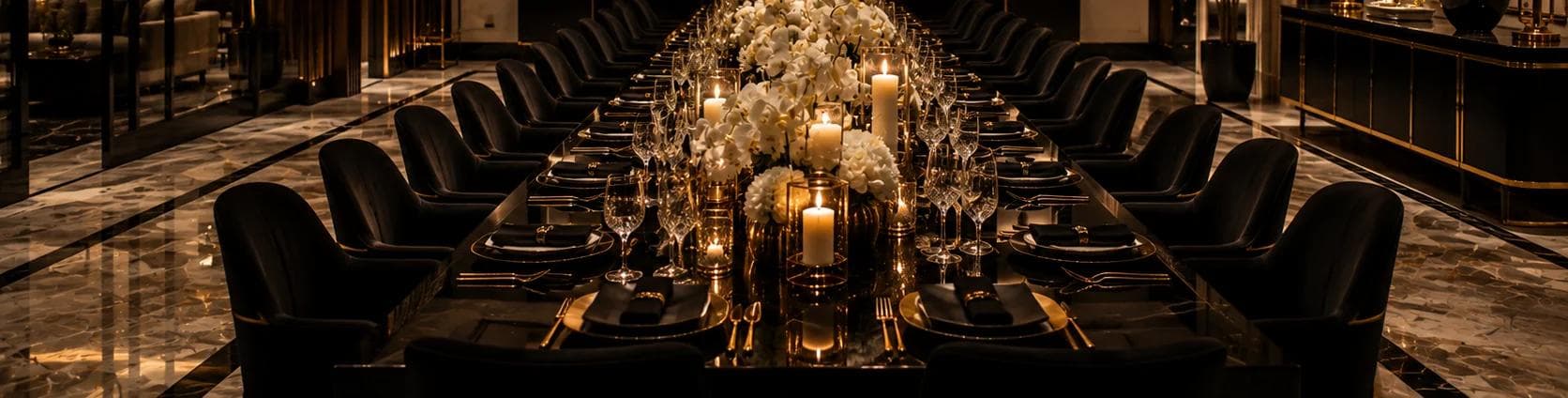
The First Five Minutes Shape the Entire Celebration
Why the first five minutes of arrival set the emotional tone that carries through an entire celebration.
There is a brief, subtle window at every event that most hosts overlook.
It occurs long before the champagne toasts begin, before the music finds its cadence, and before the photographer captures a single frame. It happens the exact instant a guest steps across the threshold.
Within those first five minutes, a silent emotional calculation occurs: guests unconsciously decide whether they can truly unwind.
It is never a deliberate thought. No guest stands at the entrance and calculates, “The operational execution here is sound.” Instead, they feel it. Their shoulders drop. Their pace settles. Conversation becomes unforced and natural. The evening begins to breathe.
Or it doesn't.
The difference between an awkward start and a seamless entrance is rarely dramatic. It is almost always buried in tiny, invisible details:
- Was someone there to meet them the moment they stepped out of the car?
- Did they know precisely where to walk without searching for a sign?
- Were they caught in a slow-moving, congested queue at the coat check?
- Were they left standing in a crowded foyer, searching for a familiar face?
Minor moments of friction carry a surprisingly heavy tax. One unanswered question leads to another. Guests become subtly self-conscious, pausing at doorways and scanning the room for cues. Instead of being swept into the atmosphere, they are forced to spend energy navigating logistics.
Good hospitality resolves that burden. Exceptional hospitality ensures the guest never realizes the burden existed in the first place.
Hospitality as an Emotional Transition
Arrivals are emotional shifts, not logistical bottlenecks.
Every guest arrives carrying the residual weight of the outside world. Some are stepping straight out of intense boardrooms. Others have negotiated miles of dense city traffic. Some enter energized; others carry the quiet fatigue of long-distance travel or personal demands. Family members may be reuniting after years apart, while complete strangers are preparing to sit side by side for dinner.
THE CURATION OF ARRIVAL
LOGISTICAL ARRIVAL
Checking a guest list at a crowded entrance table.EMOTIONAL TRANSITION
LOGISTICAL ARRIVAL
Directing guests toward a general gathering space.EMOTIONAL TRANSITION
LOGISTICAL ARRIVAL
Handling coat check and luggage as a transaction.EMOTIONAL TRANSITION
The true purpose of hospitality is to bridge the gap between the chaotic outside world and the serene atmosphere the host has created. That transition requires acute observation and deep sensitivity.
It starts with something remarkably direct: recognition.
There is a distinct comfort in being recognized immediately upon arrival. It is not about flattering ego; it is about providing instant psychological reassurance that one is expected, welcomed, and in the right place.
Luxury is rarely about doing more. It is about noticing more.
True recognition goes far beyond knowing a name. It means understanding human context:
- Knowing which guest appreciates a quiet, low-key entry versus an immediate introduction to the host.
- Ensuring an elderly parent is gently escorted rather than given spoken directions across a vast estate.
- Anticipating that a guest arriving straight from a long flight needs a quiet moment and a glass of water before being introduced into a high-energy group.
The Science of Invisible Ease
The most remarkable moments in event management are often completely invisible.
A refreshing drink offered before a guest feels thirsty. A friendly guide materializing just as someone looks around for the restroom. A discreet team member quietly taking care of a misplaced coat or travel bag before it becomes a distraction.
Guests rarely remember these small interventions as individual acts. Instead, they leave with the enduring impression that the evening possessed a natural, magic-like rhythm.
At Maison Doclar, we design celebrations by physically and mentally tracing the arrival path from every perspective. We step into the shoes of every guest profile and walk the entry points. We look for hesitation triggers:
- Where does lighting drop too abruptly?
- Where could a guest feel unsure about where to step next?
- Where do natural bottlenecks form, interrupting flow?
- Where does a conversation naturally stall if a drink isn't immediately available?
The answers never point to bigger decorations or louder grand gestures. They point to the deliberate elimination of subtle uncertainties.
Setting the Floor for the Night
Hospitality is the art of making people feel completely grounded in unfamiliar surroundings. When that is accomplished within the first five minutes, guests stop analyzing the room and start focusing on the people around them.
By the time dinner is served, speeches are given, and the music swells, the emotional foundation of the event has already been set.
Arrivals set the promise; farewells seal the memory. Everything that happens in between simply fulfills what those crucial first five minutes promised: You are here, everything is handled, and you are free to enjoy.