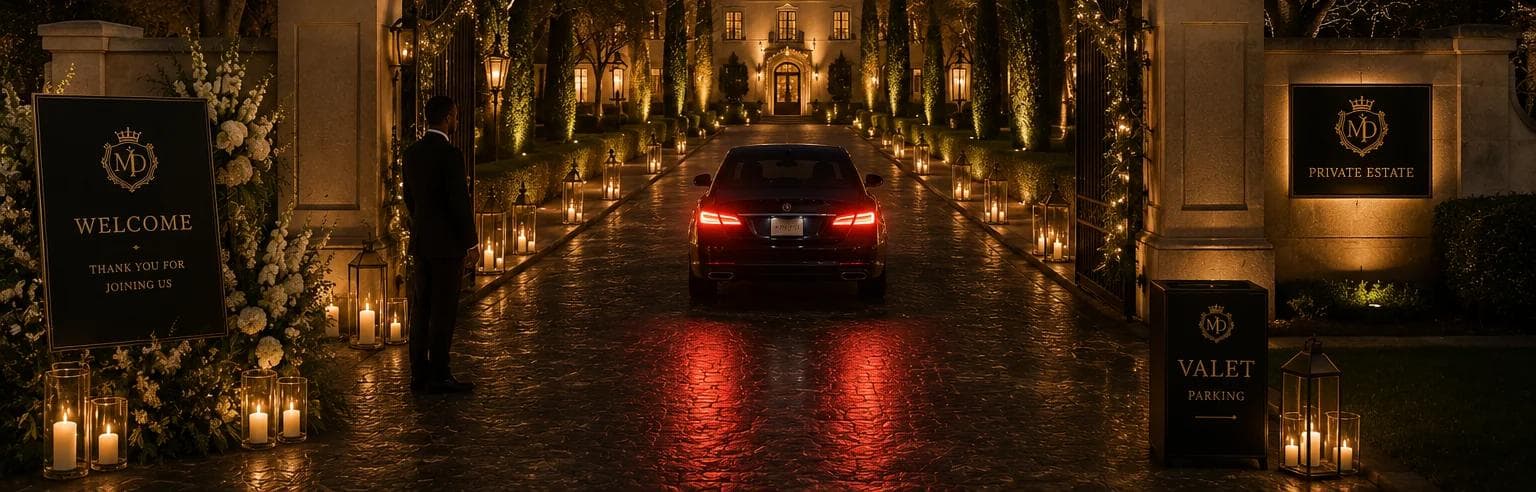
Leaving Slowly
A personal reflection on the last twenty minutes of a well-held evening, and the difference between being shown out and being sent off.
I used to think the end of a good evening was the sad part.
The coats reappear. Someone mentions traffic, or the babysitter, or an early flight. A car pulls slowly up a gravel drive, and the warmth you'd stopped noticing — because you'd finally relaxed into it — becomes suddenly, achingly obvious in its absence.
I don't think that anymore. I've come to believe the last twenty minutes of a truly well-held evening are not an ending at all. They are the last, quietest act of the same care that opened the door for you in the first place.
The Difference Between Being Shown Out and Being Sent Off
Most departures are logistics. A coat is retrieved. A car is called. A door is held. Nothing is technically wrong with any of it, and yet it can feel, somehow, like being gently returned to a world that had briefly agreed to make room for you and now no longer needs to.
I remember one evening, though, where it was different. As I stood to leave, someone I'd barely spoken to all night appeared at my elbow — not with my coat, but with a small, unhurried question about a story I'd told hours earlier, half-forgotten by then even by me. We spoke for another few minutes, standing near the door, in no rush at all.
Only after that did the coat arrive. Only after that did the car.
I didn't feel shown out. I felt sent off — which, I have since learned, is an entirely different thing.
What Stays in the Car
There is a particular quality to the quiet inside a car pulling away from a party that went well. It isn't emptiness. It's closer to the feeling after a held breath finally releases.
Someone had remembered a story I told hours earlier.
Someone had walked me to the door without checking a watch.
No one made the leaving feel like a task to be completed.
The warmth didn't end at the threshold — it simply changed shape and came with me.
I have been to evenings where the production was flawless and the farewell felt like a transaction — a coat, a door, a driveway. And I have been to far simpler evenings where the goodbye alone made me want to return, not for what was served, but for how completely I had been noticed on the way out, when there was nothing left to be gained by noticing me at all.
Care Without an Audience
That, I think, is the real test.
Generosity.
Anyone can be gracious while the room is still full and watching. The rarer thing is being cared for on your way out the door, after the toasts have ended, after the photographs have stopped, when no one but you will ever know whether the warmth was real or simply well performed while it mattered most publicly.
I have carried that particular kind of goodbye with me longer than I've carried almost anything else from those evenings. Longer than the menu. Longer than the music. It turns out the last few minutes of an evening are not where the magic wears off.
They are where you find out whether it was ever real to begin with.