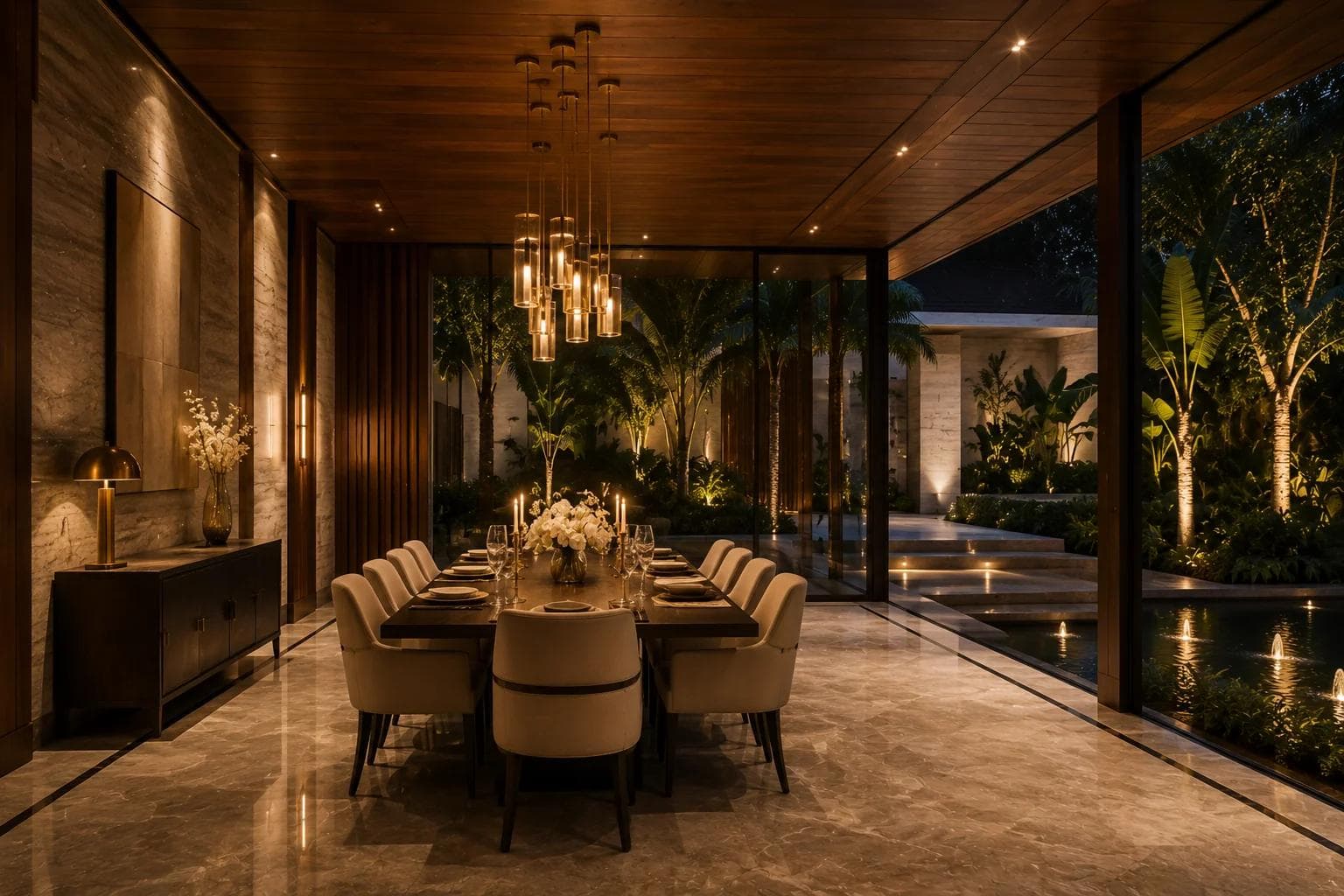
Discretion as Design: The Invisible Architecture of Hosting
Privacy and security engineered as invisible architecture, so protection is felt only as absolute, weightless freedom.
True security and privacy do not manifest as visible walls or guarded perimeters; they exist as a silent, weightless sanctuary where the host and their guests may abandon all vigilance.
I. Epigraph & Thesis
For ultra-high-net-worth individuals, public figures, and private families, the greatest luxury of all is not rare vintage champagne or custom-built staging—it is uncompromised freedom. In an era dominated by hyper-surveillance, digital leaks, and intrusive media, the ability to gather without fear of exposure has become the primary benchmark of a successful private affair.
However, conventional security measures often destroy the very atmosphere they are hired to protect. Heavy-handed guards, visible metal detectors, and restrictive protocols project paranoia, forcing guests into a state of hyper-awareness.
The thesis of structural discretion is absolute: discretion must be engineered as an invisible architectural element. Privacy and high-level security must be integrated so seamlessly into the venue's spatial flow and operational mechanics that guests never register their presence—experiencing only absolute composure and sanctuary.
II. The Invisible Architecture
High-profile guest management requires constructing two parallel operational worlds within a single estate or venue: the light space inhabited by the guests, and the dark space operated by security, logistics, and service protocols.
When discretion is designed correctly, the boundaries between these worlds are absolute yet visually imperceptible. Sightlines from exterior perimeters are neutralized through structural landscaping and photometric control. Service access routes are decoupled from guest corridors, allowing private security details, domestic staff, and medical contingencies to move fluidly behind false walls or concealed architectural baffles.
By removing the visual and psychological evidence of security, the environment invites guests to shed their public personas. The physical space becomes an emotional sanctuary where candid dialogue, authentic laughter, and total vulnerability can flourish safely.
III. Principles of Execution
Embedding absolute discretion into a private event requires four core operational frameworks executed with clinical precision.
1. Spatial Counter-Surveillance and Sightline Neutralization
Protecting an estate from external intrusion—whether long-range optics, drones, or acoustic interception—demands rigorous physical and technological shielding:
- Perimeter Shadowing: Utilizing temporary mature trees, architectural screens, and specialized tensioned fabrics to eliminate line-of-sight from exterior elevated viewpoints or public borders.
- Acoustic Scrambling: Deploying tuned directional pink-noise emitters and water-curtain features along perimeter walls to neutralize parabolic microphone interception.
- Airspace and RF Monitoring: Establishing private RF (radio frequency) monitoring grids to detect unauthorized drone activity or rogue cellular transmissions before they breach the property line.
2. Frictionless Non-Disclosure and Digital Hygiene
Enforcing privacy protocols must never feel punitive or intrusive to arriving guests:
- Zero-Touch Device Management: Rather than confiscating mobile devices at the threshold—an act that induces friction and anxiety—utilize custom signal-shielding pouches or Faraday cloak zones in sensitive salons.
- Invisible NDA Protocols: Incorporating non-disclosure and privacy terms seamlessly into digital RSVP confirmations and private concierge dossiers, avoiding uncomfortable paperwork checks at the door.
- Vendor Anonymization: Splitting logistics contracts across multiple independent entities so that no single vendor or sub-contractor possesses full intelligence regarding client identities, venue locations, or event dates.
3. Low-Profile Security Choreography
Executive protection teams must adapt to the aesthetic standards of the evening:
- Attire Integration: Security personnel are dressed in bespoke tailoring that mirrors guest dress codes perfectly, carrying low-profile communications concealed within bespoke lapel pins or ear-pieces.
- Decentralized Postures: Static guards standing at doorways are replaced by fluid, roving security specialists operating within natural architectural shadows and outer perimeters.
- Concealed Egress Routes: Engineering private, direct ingress and egress tunnels for high-profile principals that bypass main arrival zones without interrupting the room's energy.
4. Discreet Medical and Emergency Protocols
High-architecture host engineering accounts for every scenario with absolute calm:
- On-Site Trauma Capabilities: Staging mobile, state-of-the-art medical equipment and board-certified physicians in concealed service suites, ready to respond to any emergency within seconds.
- Silent Evacuation Routes: Pre-mapping discrete primary and secondary motorcade routes that allow immediate, silent departure without alerting other attendees or creating public alarm.
IV. Failure Modes of the Conventional
The integrity of private hosting is frequently shattered by heavy-handed or amateurish security approaches:
- The Fortress Illusion: Transforming a private estate into an armed compound, making guests feel audited rather than welcomed.
- Visible Staff Communications: Service or security personnel speaking audibly into radio earpieces or carrying visible clipboards within guest sightlines.
- Digital Vulnerabilities: Unsecured Wi-Fi networks or open digital photo booths that allow unvetted media to leak in real time.
- Third-Party Service Leaks: Failing to audit the personal mobile devices or social media activity of temporary catering, production, and floral staff prior to site entry.
V. The Residue
When discretion is elevated to a structural discipline, the host achieves the highest form of hospitality: providing a space where the world's most scrutinized individuals can simply exist without armor.
When the night concludes, no photos flood social platforms, no security incidents disrupt the peace, and no whispers escape the perimeter. What remains is a profound sense of trust—an enduring legacy of quiet mastery that establishes the host's estate as the ultimate sanctuary of private life.